What Is an ETG Test Calculator — and Why Does It Matter?
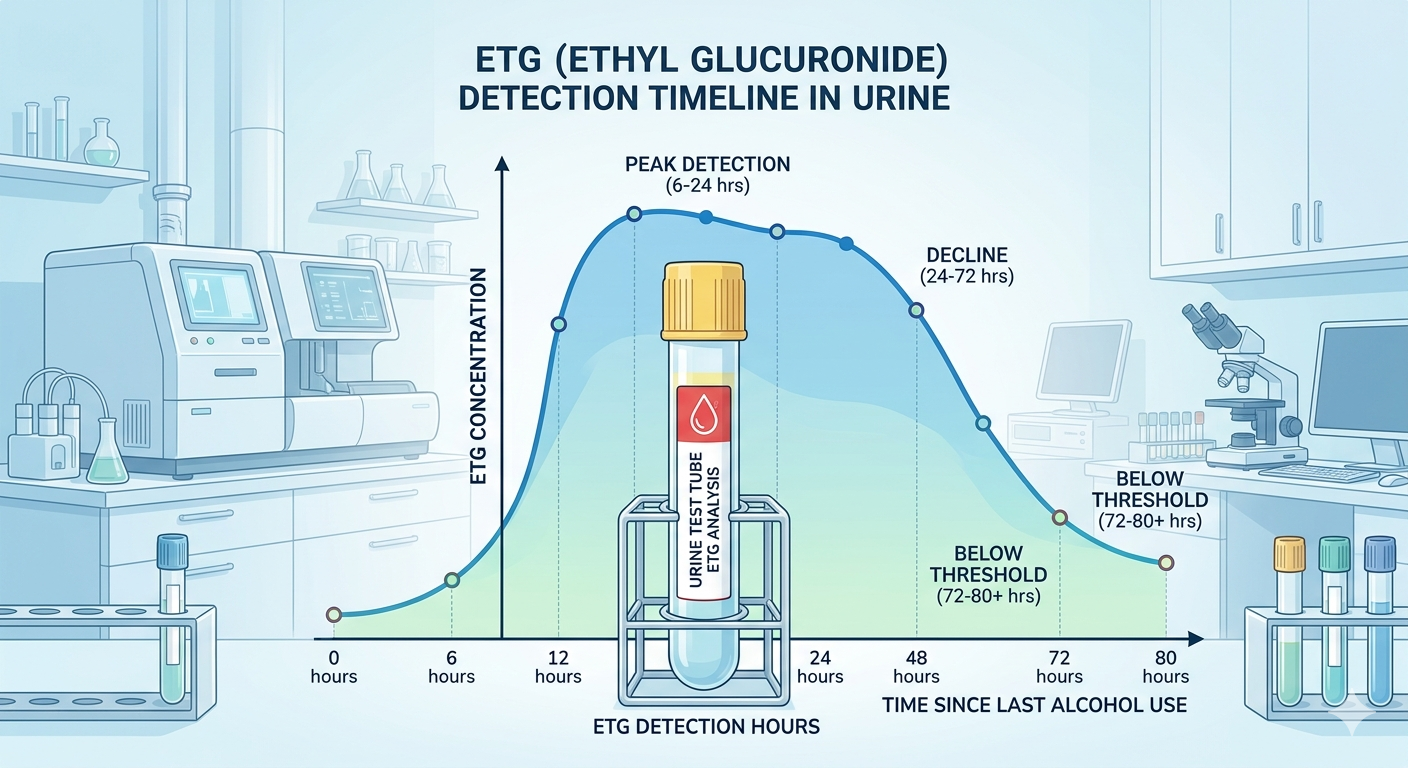
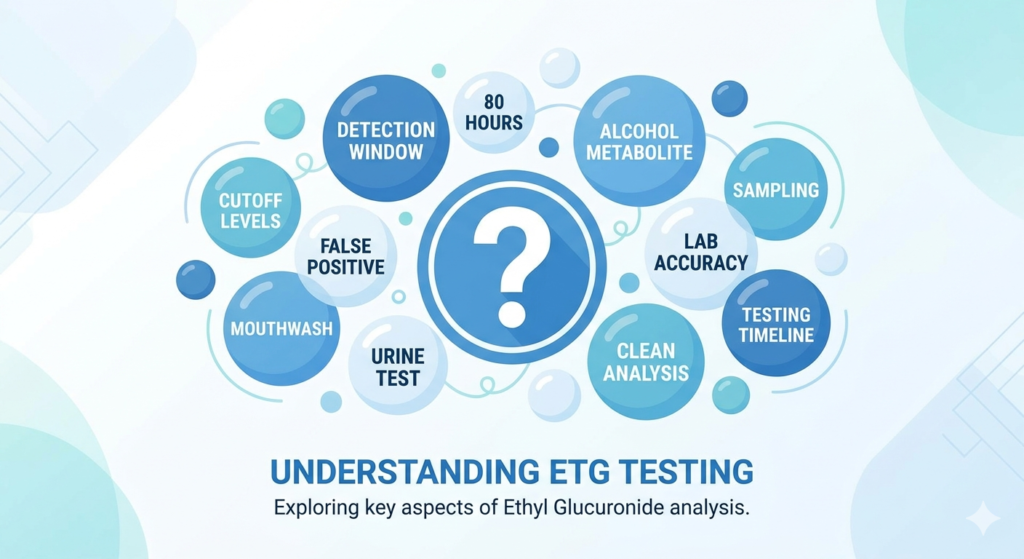
If you’ve ever faced a urine alcohol test at work, on probation, or during a treatment program, you’ve likely encountered the ETG test. Unlike a standard breathalyzer that tells you whether someone is drunk right now, an ETG test looks back in time — detecting alcohol use up to 80 hours after your last drink.
ETG stands for Ethyl Glucuronide, a direct metabolite your body produces when it processes alcohol. Because ETG stays in your urine long after alcohol itself has cleared, it has become the gold standard for verifying alcohol abstinence in legal, clinical, and workplace settings.
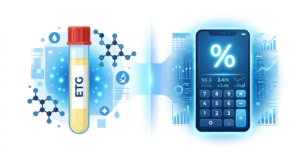
This guide explains exactly how ETG testing works, what affects detection time, how an ETG test calculator helps you estimate your risk window, and what factors cause results to vary from person to person. Test our ETG test calculator.
🧪 ETG Test Calculator
Ethyl Glucuronide (EtG) urine detection window estimator
Check Our More Tools.
What Is Ethyl Glucuronide (ETG)?
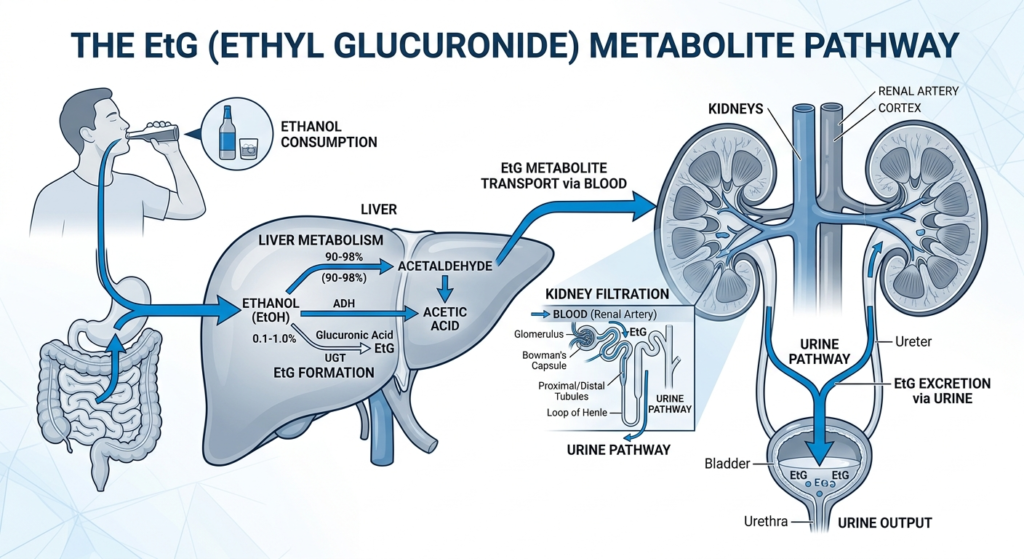
Ethyl Glucuronide is a minor metabolite of ethanol (drinking alcohol). When you consume an alcoholic beverage, your liver processes approximately 95–98% of the alcohol through primary pathways. A small fraction — roughly 0.02% to 0.05% of the ethanol — is converted into ETG through a process called glucuronidation.
Unlike ethanol itself, which breaks down relatively quickly, ETG is water-soluble and gets filtered into the urine, where it can remain detectable for a significantly longer window. This is what makes ETG testing so valuable for compliance monitoring: even if a person appears sober and shows zero alcohol on a breath test, a urine ETG test may still return positive if alcohol was consumed within the prior 2–3 days.
According to the Substance Abuse and Mental Health Services Administration (SAMHSA), ETG is recognized as a highly sensitive biomarker for alcohol consumption, particularly in contexts where complete abstinence must be verified.
How Long Does ETG Stay in Your System?
This is the most important question — and the most complicated one, because the answer is: it depends. However, we can define a general framework that the ETG test calculator uses as its foundation.
General ETG Detection Windows
| Drinks Consumed | Estimated ETG Window | Detection Risk |
| 1–2 drinks | 24–48 hours | Low to Moderate |
| 3–5 drinks | 48–72 hours | Moderate to High |
| 6+ drinks / binge | Up to 80 hours | High |
| Heavy regular use | 80+ hours (varies) | Very High |
The 80-hour figure comes from studies on heavy drinkers and is considered the outermost edge of the detection window. Most ETG calculator tools, including the ones built for conservative risk estimation, use 80 hours as their upper bound to avoid giving false reassurance.
Research published in the Journal of Analytical Toxicology confirms that ETG detection windows vary significantly based on individual physiology, the amount consumed, and the laboratory cutoff threshold applied.
What Is an ETG Test Calculator?
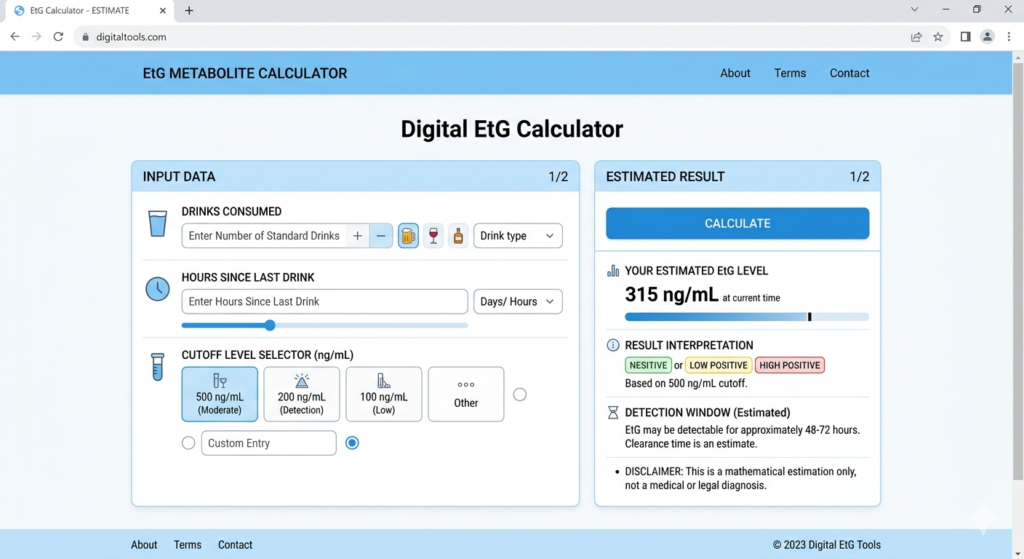
An ETG test calculator is an online tool that estimates how long ETG will remain detectable in your urine based on inputs such as:
- The number of standard drinks consumed
- The time elapsed since your last drink
- Your body weight (some calculators)
- The ETG cutoff threshold used by the testing lab (100, 200, or 500 ng/mL)
- Whether drinking was a single episode or repeated over days
These ETG test Calculators do not provide a guarantee — they provide an estimate. Human metabolism varies enormously. Two people who drank the same amount at the same time may clear ETG at completely different rates. However, a well-designed ETG calculator gives you a realistic, conservative risk window to work with.
How to Use an ETG Calculator: Step-by-Step
Step 1: Count Your Standard Drinks
A standard drink in the United States contains 14 grams of pure alcohol, which equals:
- 12 oz of regular beer (5% ABV)
- 5 oz of wine (12% ABV)
- 1.5 oz of distilled spirits like vodka or whiskey (40% ABV)
A common mistake is underestimating drink count. A large restaurant pour of wine is often 8–9 oz — nearly two standard drinks. A “pint” of beer at 7% ABV counts as more than one standard drink. When in doubt, round up.
Step 2: Note the Time of Your Last Drink
ETG doesn’t begin clearing the moment you stop drinking. Your liver needs time to process remaining alcohol, and ETG levels actually peak several hours after your last drink — typically around 3 to 5 hours post-consumption. After that peak, ETG clears at a rate influenced by your metabolism, hydration, kidney function, and body composition.
Step 3: Choose the Right Cutoff Level
The cutoff level is the threshold your testing laboratory uses to classify a result as positive or negative. This is a critical variable that many people overlook.
| Cutoff Level | Common Use Case |
| 100 ng/mL | Highly sensitive — detects even minor/incidental exposure |
| 200–250 ng/mL | Balanced — used in many treatment programs |
| 500 ng/mL | Standard — most workplace and probation programs |
If you don’t know the cutoff your test uses, assume 100 ng/mL (the most sensitive). This gives you the most conservative — and safest — estimate.
Step 4: Interpret the Result
A good ETG calculator will output either an estimated time when your ETG levels drop below the threshold, or a risk level (high / moderate / low). Always treat the output as a conservative estimate — not a guarantee of passing.
Factors That Affect ETG Detection Time
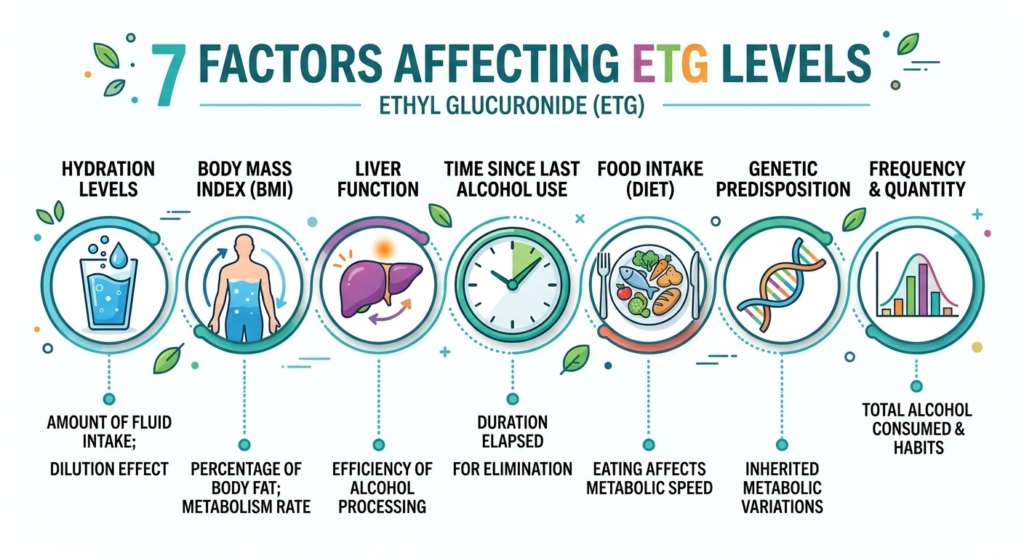
No two people metabolize ETG at exactly the same rate. Here are the key variables that influence how long ETG remains detectable in your urine:
1. Amount of Alcohol Consumed: The more you drink, the more ETG your body produces. After a single drink, ETG may clear within 24 hours. After heavy binge drinking, ETG can persist for 72–80 hours or longer.
2. Frequency of Drinking: Chronic heavy drinkers tend to produce more ETG per drink and may take longer to clear it than occasional drinkers, due to differences in enzyme activity and liver function.
3. Individual Metabolism: Genetic differences in liver enzyme activity (particularly the UGT enzymes responsible for glucuronidation) mean that some individuals naturally produce more ETG than others, even after identical alcohol intake.
4. Hydration Levels: Being well-hydrated dilutes urine and lowers ETG concentration. This can push a result below a high cutoff threshold (like 500 ng/mL) but is much less likely to help with highly sensitive tests (100 ng/mL). Drinking excessive water does not eliminate ETG — it can only affect the concentration in a given sample.
5. Body Weight and Composition: Alcohol distributes primarily in body water. Individuals with lower body water percentage (lower lean mass) may experience higher ETG concentrations for a given amount of alcohol consumed.
6. Kidney and Liver Function: Impaired kidney or liver function can slow the clearance of ETG. People with chronic liver disease, in particular, may have significantly prolonged ETG detection windows.
7. Food Intake: Eating before or during drinking slows alcohol absorption, which can reduce the peak ETG level produced.
ETG Cutoff Levels Explained: 100, 200, and 500 ng/mL
The cutoff level is one of the most misunderstood aspects of ETG testing. Many people assume a test is simply “positive” or “negative,” but in reality, whether a result registers as positive depends entirely on what threshold was set for that specific test.
100 ng/mL Cutoff
This is the lowest and most sensitive standard cutoff used in ETG testing. At this level, even minor exposure — from mouthwash, some medications, or foods prepared with alcohol — can potentially trigger a positive result. This cutoff is typically reserved for programs with strict zero-tolerance policies where any alcohol exposure must be flagged.
500 ng/mL Cutoff
The 500 ng/mL cutoff is the most widely used in standard workplace and probation testing. At this threshold, incidental exposure (mouthwash, hand sanitizer) is much less likely to cause a positive. However, consuming even 1–2 drinks within 48 hours can still produce levels well above this threshold.
For detailed information on ETG cutoff levels and their applications, the National Institute on Alcohol Abuse and Alcoholism (NIAAA) offers authoritative resources on alcohol biomarkers used in clinical settings.
Can an ETG Test Produce a False Positive?
This is a common concern, especially for people who don’t drink but are subject to regular testing. The short answer: yes, false positives are possible, but modern testing protocols are designed to minimize them.
Products that contain trace amounts of alcohol include:
- Mouthwash and breath fresheners (especially alcohol-based formulas)
- Hand sanitizers (frequent use with heavy skin absorption)
- Certain cough syrups and liquid medications
- Cooking sauces and desserts made with wine or spirits
- Kombucha tea (fermented, may contain up to 3% alcohol)
- Non-alcoholic beers (may contain up to 0.5% ABV)
At the 500 ng/mL cutoff, incidental exposure from these sources rarely produces a positive result. At 100 ng/mL, the risk of a false positive from heavy mouthwash use is real and documented in clinical literature. If you face an ETG test and are concerned about incidental exposure, switching to alcohol-free personal care products and avoiding alcohol-containing foods in the 72 hours before a test is the safest approach.
ETG Test vs. Breathalyzer vs. Blood Alcohol Test
Understanding how ETG testing compares to other alcohol detection methods helps clarify when each tool is appropriate:
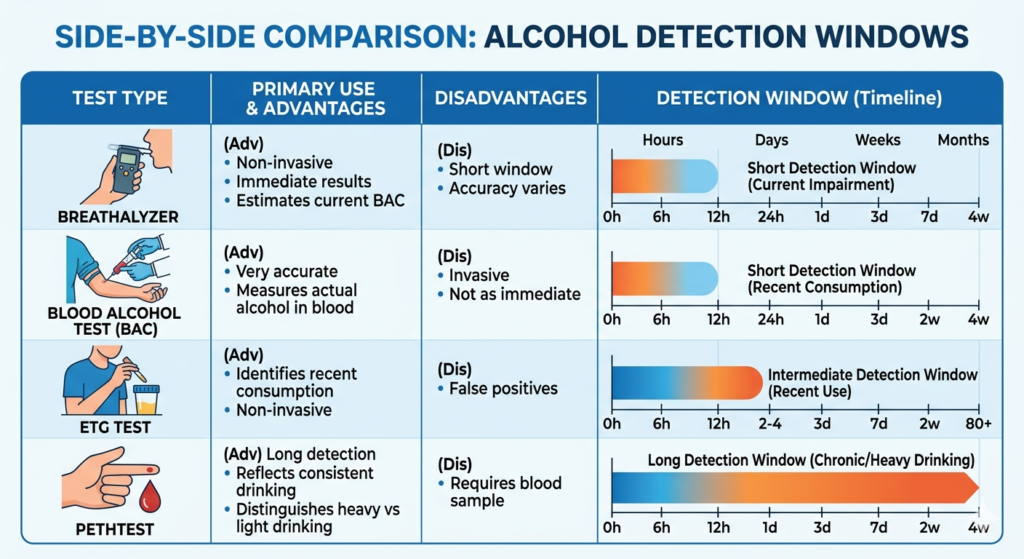
Breathalyzer (Breath Test): Measures current Blood Alcohol Content (BAC). It can only detect alcohol consumed in the past few hours. Once a person’s BAC reaches zero, a breath test cannot detect prior drinking. Detection window: 12–24 hours maximum.
Blood Alcohol Test: Direct measurement of alcohol in the bloodstream. More accurate than a breathalyzer for current intoxication but shares the same limitation — once alcohol clears the blood (typically within 12 hours), the test returns negative. Not useful for verifying past abstinence.
ETG Urine Test: Does not measure alcohol directly. Measures the ETG metabolite, allowing detection of alcohol consumption up to 80 hours after drinking. This makes it uniquely suited for compliance monitoring, probation testing, and treatment verification.
PEth Blood Test: Phosphatidylethanol (PEth) is another alcohol biomarker found in the blood. PEth has a much longer detection window — up to 21–28 days — making it useful for detecting chronic alcohol use rather than a single episode. Often used in child custody cases, liver transplant evaluations, and similar high-stakes settings.
ETG Testing in Legal Settings: Probation and Court-Ordered Testing
ETG testing has become the standard tool in legal and probation settings where alcohol abstinence must be verified. If you are on probation, participating in a DUI program, in a custody dispute, or monitored by a drug court, you have very likely encountered or will encounter ETG testing.
How Probation ETG Testing Works
Probation officers and court programs typically use the 500 ng/mL cutoff for standard testing, though some programs — particularly those involving prior alcohol-related offenses — may use the 100 or 200 ng/mL threshold. Testing may be random or scheduled, and the consequences of a positive result vary by jurisdiction and program.
Challenging a Positive ETG Result
If you believe you received a false positive, you have the right to request a confirmatory test using a more specific method such as gas chromatography-mass spectrometry (GC-MS or LC-MS/MS). These confirmation methods are far more specific and can distinguish between alcohol consumption and incidental exposure. Always consult a qualified attorney before attempting to dispute an ETG result in a legal context.
The American Society of Addiction Medicine (ASAM) has published clinical guidance on the appropriate use and interpretation of ETG testing in both treatment and legal settings.
How to Support Natural ETG Clearance (Evidence-Based Tips)
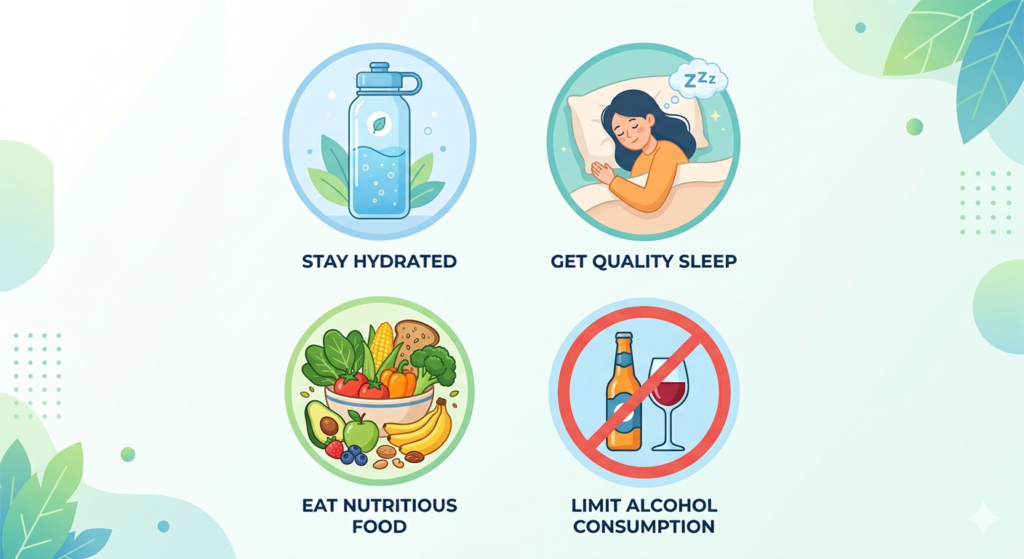
There is no proven method to “flush” ETG from your system faster than your body naturally clears it. However, the following strategies support your body’s normal metabolic processes:
- Stay well-hydrated — drink water steadily, not in extreme amounts
- Avoid further alcohol consumption entirely
- Get adequate sleep (liver repair and metabolic function peak during sleep)
- Eat balanced meals to support liver enzyme activity
- Avoid alcohol-containing products (mouthwash, medications)
- Do not attempt extreme water loading — this is dangerous and can cause hyponatremia (low sodium)
Importantly: the only reliable way to pass an ETG test is to not drink alcohol within the detection window for your specific test, based on your individual metabolism and the cutoff level being used.
What the ETG test Calculator Should — and Shouldn’t — Tell You
Based on a review of the most commonly used online ETG calculators, most tools provide one of two things: a simple elapsed-time estimate based on the 80-hour window, or a more sophisticated calculation incorporating drinks, weight, and cutoff levels. The latter is more useful because it accounts for real variation in ETG production.
However, all ETG calculators share an important limitation: they are estimation tools, not medical diagnostics. They cannot account for individual genetic variation in glucuronidation enzymes, unknown kidney function, medication interactions, or the exact alcohol content of every drink consumed. Use them as risk awareness tools, not as guaranteed predictions.
If you are facing an ETG test in a treatment or clinical context, speaking with a healthcare provider or addiction specialist is always recommended. SAMHSA’s National Helpline (1-800-662-4357) is a free, confidential service that can connect you with local resources.
Frequently Asked Questions About ETG Testing
Online ETG calculators provide useful estimates based on known metabolic averages, but they are not perfectly accurate for any individual. Individual variation in metabolism, enzyme activity, and kidney function means that actual clearance times may differ from calculated estimates. Always treat calculator output as a conservative guideline, not a certainty.
Yes — especially if the test uses a 100 ng/mL cutoff and testing occurs within 24–48 hours of that drink. A single standard drink can generate ETG levels well above 100 ng/mL in the first 12–24 hours after consumption.
Hydration can reduce the concentration of ETG in urine (a dilution effect), but it does not speed up the metabolic process that clears ETG from your system. At 100 ng/mL sensitivity, dilution is unlikely to make a significant difference. At 500 ng/mL, hydration may push borderline cases below the threshold, but this is not reliable.
Standard drug panels test for illicit substances (marijuana, cocaine, opioids, etc.) and do not include ETG unless specifically ordered. ETG is a separate, specific test added to panels when alcohol abstinence monitoring is required. If you are unsure whether your test includes ETG, ask the testing administrator directly.
ETG (Ethyl Glucuronide) and ETS (Ethyl Sulfate) are both alcohol biomarkers detectable in urine. ETS has a shorter detection window (typically 24–48 hours) but is less susceptible to false positives from non-drinking sources. When both markers are measured together, laboratories can better distinguish genuine alcohol consumption from incidental exposure.
Yes. ETG can be detected in hair follicles for months after alcohol consumption, providing a much longer detection window than urine. Hair ETG testing is not as common as urine testing but is used in some custody proceedings and chronic alcohol monitoring programs.
Conclusion: Using an ETG Calculator Responsibly
An ETG test calculator is a valuable tool for understanding your alcohol detection risk window — particularly if you are subject to probation, workplace, or treatment-program testing. The key takeaways from this guide are:
- ETG is detectable in urine for up to 80 hours after drinking, depending on consumption, metabolism, and cutoff threshold
- The cutoff level (100, 200, or 500 ng/mL) dramatically affects whether a result registers as positive
- Online ETG calculators provide conservative estimates — they should not be treated as guaranteed predictions
- Individual variation in metabolism means actual clearance times differ from person to person
- The only certain way to pass an ETG test is to abstain from alcohol for the appropriate window before testing
- False positives are possible but become much less likely at higher cutoff thresholds
If you are struggling with alcohol use or finding it difficult to remain abstinent for testing, that may be a sign that additional support could help. There is no shame in seeking assistance — evidence-based treatment for alcohol use disorder is effective and widely available.